Beautiful Abandon in Dormant Spaces
There’s been a lot of hype recently about an online post featuring a series of photographs of disused, abandoned, ruined and isolated places. Obviously, this sort of things is right up our street.
Part of Bridewell’s philosophy is to make the most of empty spaces, to exploit the beauty in older buildings instead of demolishing them or letting them go to seed. Old Bridewell Police Station wasn’t a gem to look at when we moved in, and nor are any of the concrete behemoths lining Nelson Street; however, they all have their own sort of charm and – as Bridewell quite nicely proves – can be turned into perfect affordable office space, band rehearsal rooms, cheap art studios and much besides.
Inspired by the initial blog post, we have a series of posts coming up on a similar theme – looking into a few of the buildings from the initial post in a bit more detail (look away if that destroys their charm for you…); visual examples of how we and our tenants have converted the inner shell of Bridewell in a thriving and vibrant space, and our own impressive-abandoned-places post focussed on Bristol.
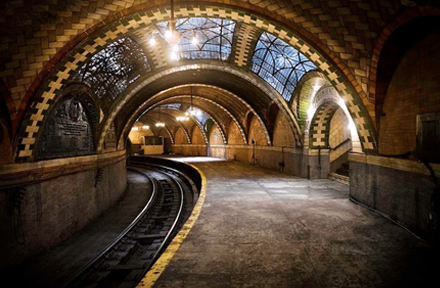
The photo on Frances’ blog that stood out the most for me – and this may very well just be because I’ve always had a strange sort of affinity for public transport and its rather well-hidden charms – is the Abandoned City Hall Subway Stop in New York. We all know subways can be pretty grotty (the one that’s stands out most in my mind is Glasgow’s – sorry Glasgow!), but this one is spectacular.

It strikes an odd sort of balance with what I wrote about at the beginning of the article – it’s not been left to fall into ruin, but it’s not being used or showcased in any way either. The station was designed in 1904, and boarded up in 1945. It looks so well-preserved because, between 1945 and now, there were plans to use it as a transit museum; those plans were thoroughly put to bed after security precautions went up after 9/11. So the old station lives in a sort of limbo – beautifully done up, enticing, begging to be used… But not able to be. However, if you happen to be lucky enough to live in or be passing through New York, you can still catch a glimpse of its splendour. If I could, I definitely would.
If you’re not keen on a subway-based tangent, scroll down now. The above picture and website got me thinking about underground systems in different countries, and in particular about one a bit closer to us British – Stockholm’s, often publicised as ‘the world’s longest art gallery’. The city’s metro was set up in 1950 and now has over 100 stations. At least 90 of those stations show off artwork of a range of types – mosaics, sculptures, paintings, installations… Some of the stations (especially on the Blue Line) have the original rock exposed from when they were first dug out; the pictures say it all really.

The Kungsträdgården station has the remains of a palace; Rissne has a fresco about the history of Earth’s civilisation; Solna Centrum has a cavernous, bright red ceiling and walls that depict a spruce forest one kilometre long. Bristol doesn’t have an underground system at all. Jealous much? I am…
Okay, tangent over. The next one that caught my eye was one that showed how ruin can be useful; if something’s going to disintegrate gracefully, sometimes it’s best to just let it be (with a little bit of green-fingered help, perhaps) – like 12th century church St Dunstan-in-the-East in London. Big cities sometimes get a bit much, and it’s nice to have a rural oasis in the middle of them. The ruins of St Dunstan’s are now a public garden, adorned with all sorts of colourful flowers. Sometimes the odd outdoor church service is held there (British weather permitting).

It could be argued that this particular church was never quite built to last. It was damaged in the Great Fire of London in 1666, patched up, the nave roof was too heavy, the structure was basically unsound, and it was heavily damaged in the Blitz in 1941. Now it’s a public garden, a grade I listed building and the home of the All Hallows House Foundation. Definitely better than a high-rise development any day. And – spoiler alert – how do you think it compares to Bristol’s own St Peter’s Church in Castle Park…?
And finally (for now), the House of the Bulgarian Communist Party on Mount Buzludzha in central Bulgaria. Mainly because, when I first saw the picture, I couldn’t really figure out what was going on in it (I’m still not really sure I do, but I’m definitely closer).

The building of the House was funded by voluntary and obligatory donations and took seven years to construct, with over 6000 workers doing construction work and over 20 artists decorating the interior. Verses of “The International” and “The Worker’s March” were inscribed on the entranceway. The main hall is 15 metres high, and a pylon on the top of the monument was 70 metres high, with two 12 metres stars of ruby glass. The end of the building’s splendour came in 1991, when it was ceded to the state and left abandoned; it has fallen prone to looters and the elements since. Neither maintaining nor dismantling the monument is an attractive prospect for the authorities – the former might imply respect for a now defunct party, but the latter would suggest disrespect for the country’s past (and upset people who still sympathise with it).
Those were my three favourites; they’re all definitely worth a look though. And if that’s not enough for you, check out this and this, and stay tuned for more abandoned buildings blog action.